Received Pronunciation: Complete Course
Learn the accent spoken by British newsreaders, presenters, and the top British actors in Hollywood.
Most adult learners struggle with accents because they jump straight into repeating native speakers. If your brain can’t distinguish the subtleties, “listen and repeat” only reinforces your native language’s phonetic habits. Children absorb accents unconsciously, but adults need a structured approach.
This course focuses on both input and output:
First, input and recognition. You will learn to hear the distinctions between target sounds and understand the physical movements required to articulate them correctly.
Then, output and production. Once you understand how to position the articulators, targeted listen-and-repeat drills actually work. You will build real muscle memory and transition naturally from isolated sounds to fluid speech.
I developed this framework while achieving fluency in Japanese and Korean, where I realised accent mastery requires an understanding of the nuances that native speakers can take for granted. I apply the same rigorous approach to teaching Received Pronunciation.
Course Overview
Part 1: The Tools of Phonetics
We begin with the tools to identify the sound of English.
The International Phonetic Alphabet (IPA): A visual representation of the 20 vowel sounds and 24 consonant sounds, eliminating confusion.
The Vowel Sound Chart: A grid that maps where the tongue is positioned for each vowel sound.

Part 2: The 44 Phonemes (Isolation)
We’ll analyse each of the 20 Vowel Sounds and the 24 Consonant Sounds in isolation. For each sound, we will determine:
Tongue Position: Open vs Close, Front vs. Back.
Mouth Shape: Rounded vs. Unrounded.
Aspiration: The release of air (important for stops like /p/, /t/, /k/).
Part 3: Identifying the Sounds
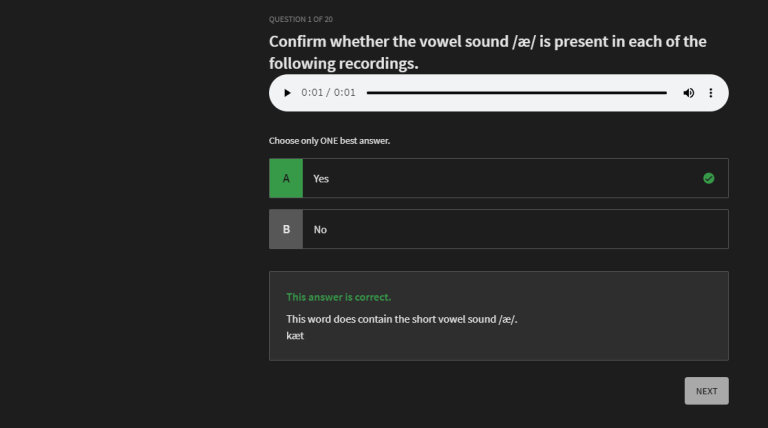
Before drilling, we’ll tune your ears to help you differentiate the phonemes. We use “Minimal Pair” exercises to isolate the target sounds.
Part 4: Stress & Rhythm (The Schwa)
English is a stressed-timed language with “Stressed” and “Unstressed” syllables.
We focus on the Schwa (/ə/), the most common sound in English, which allows for the natural, flowing rhythm of RP.
We practice Vowel Reduction, ensuring you do not over-pronounce weak syllables.
Part 5: Muscle Memory & Automation
Knowledge is not fluency. To speak naturally, the movements must be automated. We use repetition drills to train the articulators (lips, tongue, jaw, etc) to move correctly without conscious thought. This allows you to focus on what you are saying, not how you are saying it.
Included Resources
Video Library: Detailed breakdown of the articulation for each sound.
Diagrams: Visual guides for tongue placement.
Native Speaker Analysis: Breakdowns of speeches by actors and business leaders to observe natural speech patterns.
Discussion Forum: Direct access to me for your questions.

FAQ
Who is the target audience for this course?
This course was mainly designed for non-native speakers (Intermediate to Advanced) who wish to learn Received Pronunciation.
What is Received Pronunciation?
Can native English speakers benefit from this course?
Yes. While the course is designed for non-natives, the mechanical breakdown is highly effective for native speakers wish to acquire an RP accent. Speakers of General American English are also recommended to explore the RP for Americans Course for a more tailored experience.
What is the expected duration of the Complete Course?
The average completion time is between 20 and 60 hours. This varies based on your current level and how rigorously you practise the drills.
Why is the Complete Course so long?
This is a training program, not a lecture. We do not just explain the sounds; we drill them. The course is designed to allow enough repetition to alter your muscle memory. You cannot rush physiology.
Is there a time limit to complete this course?
No. You have lifetime access. You can work at your own pace and return to specific modules for maintenance practice whenever needed.
Are there any prerequisites for taking this course?
While no specific prerequisites exist, a basic level of English proficiency is recommended for optimal learning. Most videos include English subtitles, and subtitles in other languages are also provided.
Can I access the course materials on any device?
Absolutely, the course is accessible on any device with an internet connection using a web browser.
Is there any support provided during the course?
Yes, you can use the discussion panel or submit any issues you may encounter directly to me.
Is the course self-paced?
Yes, the course is self-paced. Students can progress through the material at their own pace.
What happens if I need to take a break from the course?
You can progress and resume later; the course will pick up where you left off.
Are there any future discounts available for this course?
The course is priced to reflect the comprehensive nature of the material. All future content updates are included at no extra cost. Occasionally discounts are offered to those who have subscribed to the free preview.